Do Solar Panels Work On Cloudy Days? Real Output Data By Weather Type (2026)
Yes — solar panels work on cloudy days. They produce 10–70 % of their rated output depending on cloud thickness, because they use diffuse (scattered) light, not just direct sunbeams. Light overcast: 50–70 %. Heavy overcast: 15–30 %. Rain: 10–20 %. Germany — one of the cloudiest countries in Europe — has 82 GW of installed solar and only 3 peak sun hours on average. Cloudy does not mean useless. This article gives the real output numbers by weather condition, explains the physics of diffuse light, and shows how to maximize production when the sky is grey.
I live in Slovenia, where winter skies are grey for weeks at a time. My 6 kW array produced 180 kWh in December 2024 and 980 kWh in June — a 5:1 ratio. The December number is not zero. The panels produced meaningful electricity every single day, including the overcast ones. The question is not whether panels work on cloudy days, but how much they produce — and the answer is "enough to matter."
How Much Power Do Solar Panels Produce On Cloudy Days?
The key to understanding cloudy-day output is the distinction between direct and diffuse irradiance:
- Direct irradiance is the sunlight that comes straight from the sun as a beam. It casts sharp shadows. On a clear day, direct irradiance is about 800–1,000 W/m² of the total 1,000 W/m² reaching the panel.
- Diffuse irradiance is sunlight that has been scattered by clouds, atmosphere, and particles. It comes from the entire sky dome, not just the sun's position. On a clear day, diffuse is only about 100–200 W/m². On an overcast day, all irradiance is diffuse.
Solar panels convert both types equally well — a photon is a photon whether it came from the sun directly or bounced off a cloud first. The panel doesn't care about the direction; it cares about the total number of photons hitting the cell per second.
| Weather condition | Typical irradiance (W/m²) | % of STC (1,000 W/m²) | A 410 W panel produces... |
|---|---|---|---|
| Clear sky, sun overhead | 900–1,050 | 90–105 % | 370–430 W |
| Thin cirrus / high haze | 750–900 | 75–90 % | 310–370 W |
| Light overcast (bright grey sky) | 300–500 | 30–50 % | 125–205 W |
| Heavy overcast (dark grey) | 100–250 | 10–25 % | 40–100 W |
| Rain | 50–200 | 5–20 % | 20–80 W |
| Storm / very dark clouds | 30–100 | 3–10 % | 12–40 W |
Two surprises from this table:
-
Light overcast is not that bad. A bright overcast sky (the kind where you can't see the sun but the sky is uniformly bright) still delivers 300–500 W/m² — enough for 125–205 W from a single 410 W panel. That is not a rounding error; it is real, useful electricity.
-
The "edge of cloud" effect. On partly cloudy days, when the sun emerges from behind a cumulus cloud, the direct beam adds to the already-elevated diffuse light from surrounding clouds. For 30–90 seconds, irradiance can spike to 1,200–1,400 W/m² — 20–40 % above the STC reference of 1,000 W/m². Your inverter will briefly show output above the panel's nameplate rating. This is normal and the inverter is designed for it.
Do Solar Panels Charge Batteries On Cloudy Days?
Yes — at a reduced rate proportional to the irradiance.
| Condition | A 100 W panel delivers... | Time to charge 100 Ah 12 V LFP (MPPT) |
|---|---|---|
| Full sun (1,000 W/m²) | ~93 W | 2.1 days |
| Light overcast (400 W/m²) | ~37 W | 5.2 days |
| Heavy overcast (150 W/m²) | ~14 W | 13.7 days |
| Rain (100 W/m²) | ~9 W | 21+ days |
An MPPT charge controller makes a significant difference in low-light conditions. MPPT adjusts the panel's operating voltage to extract maximum power at whatever irradiance is available. A PWM controller forces the panel to battery voltage and performs worse in low light. See How Many Amps Does A 100 W Panel Produce for the MPPT vs PWM comparison.
For serious off-grid setups in cloudy climates, the solution is to oversize the panel array by 30–50 % relative to the sunny-day calculation. This ensures enough charging even on overcast days.
Do Solar Panels Work In The Rain?
Yes, with 10–20 % of rated output. Rain clouds are thick and block most direct irradiance, leaving only diffuse light.
But rain has a hidden benefit: it washes the panels. A dirty panel loses 5–15 % of output from soiling (see the soiling loss chart). After a good rainstorm, the panels are clean and the first sunny day produces noticeably more than the last sunny day before the rain. Over a year, regular rain in the Pacific Northwest and Southeast means fewer manual cleanings needed.
The one downside of rain: humidity. In the hours after a storm, high humidity can cause a thin water film on the panel surface that scatters incoming light slightly. This effect is small (1–3 % loss) and evaporates quickly.
How Cloud Type Affects Output
Not all clouds are equal. The physics depends on cloud thickness (optical depth):
| Cloud type | Altitude | Optical depth | Effect on solar output |
|---|---|---|---|
| Cirrus (thin, wispy) | 20,000–40,000 ft | Low | Minimal: 80–95 % output, sometimes invisible to output monitoring |
| Altocumulus (patchy mid-level) | 6,000–20,000 ft | Medium | Partial: 50–80 %, fluctuating as patches move across the sun |
| Stratus (uniform grey sheet) | 2,000–6,000 ft | Medium-high | Uniform reduction: 30–50 %, stable output all day |
| Nimbostratus (rain clouds) | 2,000–10,000 ft | High | Heavy: 10–25 %, steady rain reduces further |
| Cumulonimbus (storm) | 2,000–60,000 ft | Very high | Severe: 5–15 %, but storms pass quickly — output rebounds |
The best cloudy-day scenario for solar is actually partly cloudy with cumulus — the sun shines between clouds at full intensity, and the edge-of-cloud effect can push output above nameplate. A partly cloudy spring day can actually produce more daily kWh than a clear summer day because the temperature is lower (higher efficiency) and the cloud-edge spikes add up.
Cloudy Countries That Lead In Solar Power
The strongest argument that solar works on cloudy days: the countries that have installed the most solar capacity per capita include some of the cloudiest places on Earth.
Germany averages only 3.0 peak sun hours per day — less than every U.S. state except Alaska. Yet it has 82 GW of installed solar and generated 12 % of its electricity from PV in 2023. If solar didn't work on cloudy days, Germany's entire solar program would be a failure. It is not — it is one of the most successful in the world.
The Netherlands averages 2.9 peak sun hours and has more solar per capita than most sunny countries. The UK has only 2.8 PSH and is growing rapidly. Japan has a full monsoon season of clouds and rain, yet ranks 4th globally with 78 GW.
The lesson: system sizing compensates for lower sun. A German homeowner installs a 10 kW system where an Arizona homeowner installs 6 kW — and both offset their annual electricity use. The German system costs more but the electricity rates are also higher (€0.30+/kWh), so the payback math works.
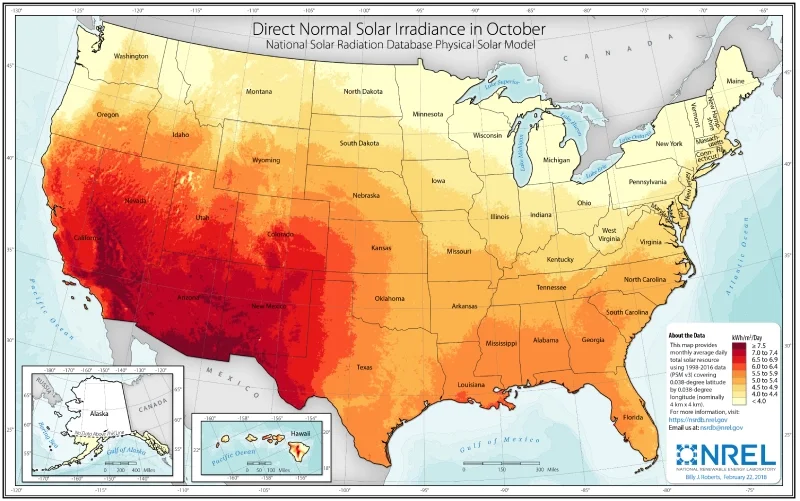
The same variation exists within the US. Arizona averages 6.5 peak sun hours while Washington gets 3.7 — but both states have thriving solar markets. See Peak Sun Hours By State for your state's exact number.
How To Maximize Solar Output On Cloudy Days
Five things you can do:
1. Keep panels clean. Diffuse light scatters more off a dirty surface than direct light does. A clean panel captures diffuse light more efficiently. See How To Clean Solar Panels.
2. Use microinverters or DC optimizers. On a partly cloudy day, some panels may be in shadow while others are in sun. String inverters pull the entire string to the lowest-performing panel's level. Microinverters and optimizers let each panel operate independently — the shaded panel produces what it can without dragging down the sunny ones.
3. Use an MPPT charge controller (off-grid). MPPT extracts 20–30 % more power than PWM in low-light conditions by tracking the panel's shifting voltage-current sweet spot.
4. Tilt for maximum sky exposure. In cloudy climates, diffuse light comes from the entire sky dome, not just the sun's position. A slightly lower tilt angle (latitude minus 5–10°) can capture more diffuse light than a steep tilt optimized for winter direct beam.
5. Oversize your system slightly. A system sized at 110–130 % of your annual consumption provides a buffer for cloudy weeks. The extra panels cost 10–15 % more but protect against underproduction in grey seasons.
Solar Panel Output By Month — What Cloudy Seasons Look Like
The seasonal variation in solar output is driven mostly by day length and sun angle, not by cloudiness alone. But cloudiness compounds the seasonal effect:
| Season | Typical output vs. annual avg | Why |
|---|---|---|
| Summer (Jun–Aug) | 130–160 % of avg | Long days (14–16 hrs daylight), high sun angle, but hot cells reduce efficiency slightly |
| Spring (Mar–May) | 100–120 % of avg | Moderate day length, cool air boosts efficiency, often clearer skies |
| Fall (Sep–Nov) | 80–100 % of avg | Shortening days, leaf fall and pollen can soil panels |
| Winter (Dec–Feb) | 40–70 % of avg | Short days (8–10 hrs), low sun angle, more clouds, but cold = high cell efficiency |
For my 6 kW array in Slovenia: June production was 5.4× December production. In Phoenix that ratio is about 1.5×. In Seattle it is closer to 6×. The cloudier your winters, the more important it is to bank net-metering credits in summer.
For your specific location's monthly breakdown, use the peak sun hours by state data or our solar panel output calculator.
Do Solar Generators And Chargers Work On Cloudy Days?
Portable solar generators (Jackery, EcoFlow, Bluetti, Goal Zero): yes, same physics as rooftop panels. Expect 10–30 % of nameplate charging rate under heavy clouds. The panels are smaller and more sensitive to orientation — on a cloudy day, point them straight up at the brightest part of the sky rather than toward the hidden sun.
Phone solar chargers (small foldable 5–20 W panels): barely. These tiny panels produce 0.5–2 W in heavy overcast — enough to trickle-charge a phone over 8+ hours, but not enough for meaningful battery replenishment. They work best as supplemental charging in combination with a power bank.
Bottom Line
Solar panels work on cloudy days. They produce 50–70 % of rated output in light overcast, 15–30 % in heavy overcast, and 10–20 % in rain. The physics is simple: panels convert diffuse light just as effectively as direct light — there are just fewer total photons on a cloudy day. Germany, Japan, the UK, and the Netherlands prove the point at national scale: cloudy countries are among the world's largest solar producers because system sizing compensates for lower sun hours.
If you live in a cloudy climate, solar still works. You just need a slightly larger system and realistic seasonal expectations.
Keep Reading
- How To Calculate Solar Panel Output (Watts → kWh)
- Average Peak Sun Hours By State
- STC vs NOCT — Temperature Effects On Real Output
- How To Clean Solar Panels — Step-By-Step
- Solar Panel Charge Time Calculator
- Are Solar Panels Worth It? — ROI Calculator
- How Long Do Solar Panels Last — 25-Year Degradation
- How Many Amps Does A 100 W Panel Produce
- Solar Panel Calculator — Full Energy Estimate
Frequently Asked Questions
Do solar panels work on cloudy days?
Do solar panels charge on cloudy days?
Do solar panels work in the rain?
Do solar panels work at night?
Do solar panels work in fog?
Do solar panels work in snow?
Do solar panels work better in cold or hot weather?
What is the 'edge of cloud' effect?
Do solar generators work on cloudy days?
Sources
- IEA PVPS — Snapshot of Global PV Markets 2024
- NREL — National Solar Radiation Database (NSRDB): Diffuse vs Direct Irradiance
- PVEducation — Properties of Sunlight: Direct and Diffuse Radiation
- Fraunhofer ISE — Photovoltaics Report (2024)
- Thevenard, D. & Pelland, S. (2013) — Estimating the uncertainty in long-term PV yield predictions. Solar Energy 91, 406–414
- NREL PVWatts v8 — System Performance Calculator