Solar panel calculators, guides, and data for every roof in America
Free interactive tools backed by NREL government data. Size your system, calculate your savings, find your state's peak sun hours, and learn everything about solar — from how panels work to installation, financing, and maintenance. No signups, no email walls, no upselling.
From sunlight to your outlets
Solar Panels: The 5 Questions Everyone Asks First
Quick answers backed by data. Click through for the full guide with calculators, charts, and sources.
How do solar panels work?
Solar panels convert sunlight into electricity through the photovoltaic effect. Photons from sunlight knock electrons free in silicon cells, creating DC current. An inverter converts DC to AC for your home. No moving parts, no fuel, no emissions — just photons in, electrons out.
Read the full guideHow many solar panels do I need?
The average US home needs 15–25 panels (400W each) to produce 10,500 kWh/year. Arizona needs 13 panels; Massachusetts needs 22 for the same energy. The formula: annual kWh ÷ (365 × peak sun hours × 0.400 × 0.83).
Read the full guideHow much do solar panels cost?
Solar panels cost $2.50–$3.50 per watt installed in 2026 — that is $20,000–$28,000 for an 8 kW system. The federal residential tax credit (Section 25D) expired December 31, 2025, so systems you own and install in 2026 pay full price; state incentives and net metering still cut the net. Panels alone are only 10–14% of total cost; labor and overhead are the majority.
Read the full guideAre solar panels worth it?
Yes. A typical US home saves $35,000 (low-rate) to $125,000+ (high-rate) in avoided electricity over 25 years — about $47k–$69k at average U.S. rates; that value comes from your utility bill and is unaffected by the (now-expired) tax credit. Payback runs about 12 years at average rates — roughly 7 years in high-rate states (CA/MA) and 4–5 in Hawaii; longer (14–17) in low-rate states. After payback, electricity is effectively free for the remaining years of panel life. Solar adds 4.1% to home value (Zillow); state incentives and net metering still apply.
Read the full guideWhat is the solar tax credit?
The federal residential solar credit (Section 25D) was 30% of your total system cost — a $22,000 system once got $6,600 — but it expired December 31, 2025. Systems you own and install in 2026 receive no federal credit. Third-party owned systems (lease/PPA) can still use the commercial credit (Section 48E), which the provider claims. State incentives and net metering remain.
Read the full guideFree Solar Calculators
Every calculator uses NREL PVWatts v8 formulas with real-world derate factors. Input your numbers, get instant results. No signup required.
Solar Savings Calculator
ROI, payback period, and 25-year savings for your system.
How Many Panels for My House?
Panels needed by home size, state, and usage.
Battery Sizing Calculator
LiFePO4 battery bank size for off-grid or backup.
Solar Tax Credit Calculator
Federal credit expired end-2025 — state incentives + net cost by scenario.
Solar Output Calculator
Daily, monthly, yearly kWh for any panel and location.
Tilt Angle Calculator
Optimal panel angle for your latitude and direction.
Direction Calculator
Which way to face panels — yield by compass direction.
Wire Size Calculator
AWG gauge, voltage drop, and fuse size for any run.
Rooftop Sizer
How many panels fit on your roof after obstructions.
RV Solar Calculator
Appliance checklist → panels, battery, and controller.
Well Pump Sizing
Panels needed by well depth and daily water volume.
Browse by Topic
158articles across 7 topics — from the photovoltaic effect to financing and maintenance. Each topic has a “start here” article for beginners and deep guides for experienced builders.
How Solar Works
Photovoltaic effect, panel types (mono/poly/HJT), datasheet specs, and a 30-term solar glossary.
Solar Sizing & Calculators
Interactive tools for system sizing: how many panels, output by system size, rooftop fit, and tilt angle.
Solar Costs & Savings
How much solar costs, how much it saves, the expired federal tax credit, lease vs buy, net metering, and home value.
Solar Batteries & Off-Grid
Battery sizing, LiFePO4 guide, MPPT vs PWM controllers, wiring panels to batteries, and off-grid systems.
Solar Installation & Wiring
Installation process, DIY vs professional, series vs parallel wiring, and string vs microinverter.
Solar Maintenance
Panel lifespan, cleaning, monitoring, performance in snow and clouds, and troubleshooting with a multimeter.
Solar Applications
Solar for RVs, EV charging, air conditioning, well pumps, and 30+ appliance sizing guides.
Peak Sun Hours by State
Peak sun hours determine your solar production. The US averages 4.98 PSH per day, but the range from Arizona (6.54) to Alaska (3.17) means Arizona panels produce nearly twice as much energy as Alaska panels. Every calculator on this site uses state-specific NREL PVWatts data.
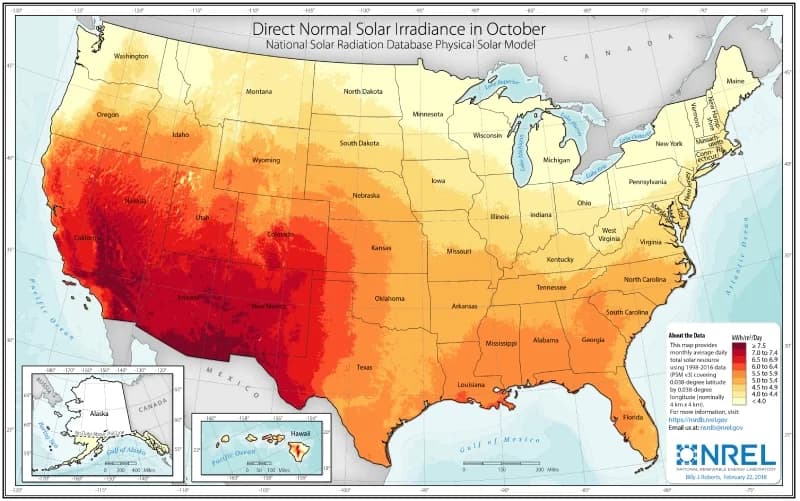
- #1Arizona6.54 PSH
- #2New Mexico6.42 PSH
- #3Nevada6.41 PSH
- #4California6.08 PSH
- #5Hawaii5.82 PSH
- #51Alaska3.17 PSH
- #50Washington3.95 PSH
- #49Oregon4.06 PSH
- #48Vermont4.36 PSH
- #47North Dakota4.45 PSH
Most Popular Guides
Deep guides with data charts, interactive calculators, and cited sources. Every article uses PVWatts v8 derate factor of 0.83 and reflects 2026 pricing and policies.
Standard Solar Panel Sizes And Wattages (100W–600W Dimensions, 2026)
Average length, width, thickness, weight, and area for 100W to 600W solar panels — built from 60+ current manufacturer datasheets (LONGi, JinkoSolar, REC, SunPower, Q CELLS, Renogy, BougeRV). Includes real model specs, roof-fit math, FAQ, and sources.
Read article →Solar Panel Calculator (2026): Size, Cost & Payback
Enter your ZIP and electric bill to get system size, panel count, cost, and payback. Built on NREL PVWatts v8 — most U.S. homes pay back in 9-14 years.
Read article →Solar Panels For EV Charging: How Many Panels To Charge Your Electric Car? (2026)
Most EVs need 6–9 solar panels (410 W each) to offset the average 37 mile/day commute. Solar EV driving costs $0.035/mile — 4× cheaper than gas. Full EV model comparison (Tesla, Chevy, Ford, Hyundai, VW), home setup guide, portable solar reality check, golf cart charging, and solar vs gas vs grid cost breakdown.
Read article →Solar Panel Tilt Angle Calculator: Best Angle by ZIP (2026)
The optimal solar panel tilt runs a few degrees below your latitude — about 33° in New York, facing true south. Enter your ZIP for the exact PVWatts angle.
Read article →Solar Panel Maintenance: Costs, Schedule & What You Actually Need To Do (2026)
Solar panel maintenance costs $150–$350/year for a residential system. The full schedule: cleaning 1–2×/year, visual inspection 2×/year, pro electrical check every 3–5 years, one inverter replacement at year 12–15. Includes the 25-year cost breakdown, inspection checklist, and maintained-vs-neglected output comparison.
Read article →Solar Panel Cost Per kWh: What Does Solar Electricity Actually Cost? (LCOE Explained)
Residential solar electricity costs $0.05–$0.10 per kWh over 25 years — less than half the U.S. average grid rate of $0.165/kWh. And unlike grid rates that rise 3%/year, solar cost per kWh is locked in at installation. Full LCOE calculation, state-by-state comparison, historical trend, and the formula to compute your own.
Read article →How To Clean Solar Panels: Step-By-Step Guide (+ What NOT To Do)
Solar panels lose 5–25 % of output from dirt, pollen, and bird droppings. Here is the correct cleaning method: garden hose, soft brush, mild soap, early morning. Plus what NEVER to do (pressure washer, abrasives), how to clean panels on a roof safely, snow removal, solar light cleaning, and the cost of professional vs. DIY.
Read article →How Much Do Solar Panels Cost? 2026 Cost Per Watt Guide
Solar panels cost $2.50-$3.50/W installed in 2026, or ~$24,800 for a typical 8 kW system before incentives. Full cost-per-watt breakdown by system size.
Read article →How Long Do Solar Panels Last? 25-Year Degradation Chart By Technology (2026)
Solar panels last 25–30 years with 80–92 % output retained at year 25. Modern n-type panels degrade at 0.25–0.5 %/year — far slower than older PERC. Full 25-year degradation table by technology (HJT, TOPCon, IBC, PERC), the physics of what actually kills a panel, inverter and battery lifespan, warranty deep-dive, and when replacement makes economic sense.
Read article →How Do Solar Panels Work? A Simple Guide to the PV Effect
Solar panels convert sunlight to electricity via the photovoltaic effect: photons free electrons in silicon cells (20-25% efficient), an inverter makes AC.
Read article →Are Solar Panels Worth It? ROI Calculator + Full Savings Breakdown (2026)
Solar panels pay back in 6–13 years and return 10–20 % annually for the remaining 15+ years. At average U.S. rates an 8 kW system saves $25,000–$75,000 over 25 years — even without the federal tax credit (ended 2025). Full state-by-state savings table, payback calculator, and the honest 'when solar is NOT worth it' scenarios.
Read article →Solar Panel Direction Calculator: Which Way to Face (2026)
Enter your ZIP and roof direction to see your annual yield vs true south, from NREL PVWatts. East/west keeps about 83%, not 50% — plus your compass fix.
Read article →About TheGreenWatt
Built by Marko Visic, physicist and solar panel owner. I installed panels on my own house, measured the real-world output, and built TheGreenWatt to share what I learned. Every calculator uses formulas from NREL PVWatts v8— the US government's solar production model. Every claim is backed by cited sources: NREL, DOE, EIA, IEC standards, Zillow research, and manufacturer datasheets. No AI-generated filler, no affiliate bias, no signup walls.
All cost and savings calculations reflect 2026 market pricing and the expiry of the federal residential tax credit (Section 25D) at the end of 2025. Panel degradation uses the Jordan & Kurtz (NREL) median of 0.5%/year for monocrystalline PERC.
More about TheGreenWatt