How Many Solar Panels To Power A House? (Calculator + By Home Size And State)
The average US home needs 15 to 25 solar panels (400 W each) to fully power the house. That is a 6–10 kW system producing about 10,500 kWh per year. The exact number depends on three things: how much electricity you use, how much sun your location gets, and what wattage panels you install. A home in Arizona needs about 13 panels. The same home in Massachusetts needs 22 panels for the same energy — the difference is entirely about sunlight.
When I sized the system for my own home, I started with my electric bill (about 8,500 kWh per year), looked up my location's peak sun hours (4.5 PSH), and divided. The math took five minutes; the result was 16 panels at 400 W (6.4 kW). Two years later, the system has produced 8,200–8,800 kWh annually — within 5 % of the calculation. The formula works.
How Many Solar Panels To Power A House? (Quick Answer)
| Home size | Typical kWh/year | Panels at 4 PSH | Panels at 5 PSH | Panels at 6 PSH | System size |
|---|---|---|---|---|---|
| Small (1,000 sqft) | 5,400 | 12 | 9 | 8 | 3.2–4.8 kW |
| Medium (1,500 sqft) | 7,800 | 16 | 13 | 11 | 4.4–6.4 kW |
| Average (2,000 sqft) | 10,500 | 22 | 18 | 14 | 5.6–8.8 kW |
| Large (2,500 sqft) | 13,200 | 27 | 22 | 18 | 7.2–10.8 kW |
| Very large (3,000 sqft) | 16,000 | 33 | 27 | 22 | 8.8–13.2 kW |
| Estate (4,000+ sqft) | 21,000+ | 43+ | 35+ | 29+ | 11.6–17.2 kW |
PSH = peak sun hours per day. Arizona gets about 6.5 PSH. The national average is about 4.5 PSH. Washington state gets about 3.7 PSH. Look up your exact number at Average Peak Sun Hours By State.
All calculations use: 400 W monocrystalline panels, PVWatts v8 derate factor of 0.83 (14 % DC system losses × 96 % inverter efficiency).
How Many Solar Panels By Home Size
Home square footage is a rough proxy for electricity usage. Larger homes have more lighting, more outlets, more HVAC load, and often more occupants. The correlation is not perfect — a well-insulated 2,500 sqft home may use less energy than a drafty 1,500 sqft home — but it gives a useful starting estimate when you do not have your electric bill handy.
A 2,000 sqft home using 10,500 kWh/year needs 13 panels in a high-sun state (Arizona, 6.0 PSH), 19 panels in an average state (Texas, 4.5 PSH), or 25 panels in a low-sun state (Washington, 3.5 PSH). Larger homes with higher energy use need proportionally more panels. These estimates assume 400 W monocrystalline panels and PVWatts v8 derate of 0.83.
Important: your actual kWh usage matters more than square footage. Check your electric bill for the real number. Most utilities show a 12-month usage history on each bill or in your online account. Add up all 12 months to get your annual kWh. That is the number to use in the formula.
Typical Monthly Usage By Home Size
| Home size (sqft) | Typical monthly kWh | Annual kWh | Notes |
|---|---|---|---|
| 1,000 | 450 | 5,400 | Apartment or small cottage |
| 1,500 | 650 | 7,800 | Small single-family |
| 2,000 | 875 | 10,500 | US average |
| 2,500 | 1,100 | 13,200 | Large family home |
| 3,000 | 1,330 | 16,000 | Above-average usage |
| 4,000+ | 1,750+ | 21,000+ | Large home, possibly with pool or EV |
These are national averages from the EIA Residential Energy Consumption Survey. Your actual usage depends on climate (AC in the South, heating in the North), insulation quality, appliance efficiency, number of occupants, and whether you have energy-intensive additions like a pool, hot tub, or electric vehicle.
How Many Solar Panels By State
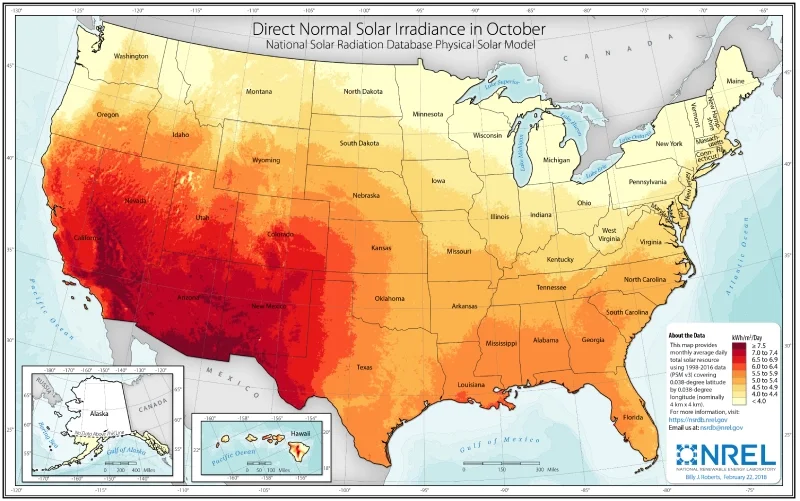
Your state determines how much sunlight your panels receive, measured in peak sun hours (PSH) per day. More sun = fewer panels needed for the same energy. The difference is dramatic: Arizona (6.57 PSH) needs nearly half as many panels as Washington (3.72 PSH) for the same annual output.
Arizona needs only 13 panels (400 W each) to produce 10,500 kWh per year because it gets 6.57 peak sun hours per day. Washington state needs 23 panels for the same energy because it gets only 3.72 peak sun hours. The difference is entirely about sunlight — the panels themselves work the same everywhere. All calculations use PVWatts v8 derate factor of 0.83 (14 % DC losses plus 96 % inverter efficiency).
Panels For 10,500 kWh/Year By Region
| Region | Representative states | PSH range | Panels (400W) | System size |
|---|---|---|---|---|
| Southwest | AZ, NV, NM, CA | 5.9–6.6 | 13–15 | 5.2–6.0 kW |
| Southeast | FL, TX, GA, NC | 5.1–5.6 | 16–17 | 6.4–6.8 kW |
| Mountain West | CO, UT, MT | 4.9–5.5 | 16–18 | 6.4–7.2 kW |
| Midwest | IL, OH, MI, MN | 4.1–4.6 | 19–21 | 7.6–8.4 kW |
| Northeast | NY, MA, PA, NJ | 4.1–4.5 | 19–21 | 7.6–8.4 kW |
| Northwest | WA, OR | 3.7–4.3 | 20–23 | 8.0–9.2 kW |
| Alaska | AK | 3.2 | 27 | 10.8 kW |
See Average Peak Sun Hours By State for the detailed data for all 51 states with monthly breakdowns.
How To Calculate Solar Panels For Your House (Step-by-Step)
Step 1 — Find Your Annual kWh
Look at your electric bill. Find the 12-month usage history (usually printed on the bill or in your utility's online portal). Add all 12 months. If you only have monthly average, multiply by 12.
Example: My bill shows I used 875 kWh last month. The 12-month total on the bill says 10,500 kWh.
Step 2 — Look Up Your Peak Sun Hours
Find your location's annual average peak sun hours at Peak Sun Hours By State. This is the number of hours per day that sunlight intensity equals 1,000 W/m² — the effective "full power" hours for your panels.
Example: I live in Colorado. My PSH is 5.49.
Step 3 — Apply The Formula
Panels = Annual kWh ÷ (365 × PSH × panel kW × 0.83)
The 0.83 is the PVWatts v8 derate factor: 14 % DC system losses (wiring, soiling, temperature, mismatch) × 96 % inverter efficiency.
Example:
Panels = 10,500 ÷ (365 × 5.49 × 0.400 × 0.83)
Panels = 10,500 ÷ 665.3
Panels = 15.8 → round up to 16 panels
System size = 16 × 400W = 6,400W (6.4 kW)
Step 4 — Check Roof Space
Each 400 W panel is approximately 1.72 m × 1.13 m = 1.95 m² ≈ 21 sqft (including mounting gaps). Multiply your panel count by 21 to get the required roof area. Make sure your usable roof area (after setbacks and obstructions) can fit that many panels.
Example: 16 panels × 21 sqft = 336 sqft of roof space needed. My south-facing roof section is about 500 sqft. Plenty of room.
See How To Calculate Solar Panel Output for the complete production calculation.
How Many Watts Of Solar To Run A House?
If you are thinking in watts rather than panel count:
| Annual kWh | System size needed (at 5 PSH) | System size (at 4 PSH) | System size (at 6 PSH) |
|---|---|---|---|
| 5,000 | 3.3 kW | 4.1 kW | 2.7 kW |
| 7,500 | 4.9 kW | 6.2 kW | 4.1 kW |
| 10,500 | 6.9 kW | 8.6 kW | 5.8 kW |
| 15,000 | 9.9 kW | 12.3 kW | 8.2 kW |
| 20,000 | 13.2 kW | 16.4 kW | 11.0 kW |
Formula: System kW = Annual kWh ÷ (365 × PSH × 0.83)
The average US home needs 6–8 kW of solar. This aligns with LBNL data showing the median US residential system size in 2025 was 7.5 kW.
How Many Solar Panels Fit On My Roof?
Not all of your roof is usable for solar. You lose space to:
- Fire code setbacks: 3 ft from ridge, 3 ft from edges (varies by jurisdiction)
- Obstructions: Chimney, plumbing vents, exhaust fans, skylights
- Shade zones: Areas shaded by trees, neighboring buildings, or other roof sections
- Structural limitations: Weak areas that cannot support panel weight (~3 lbs/sqft)
Rule of thumb: Usable solar area = total roof area × 60–75 %.
A typical 2,000 sqft roof has only 1,200–1,500 sqft of usable area for solar panels. Obstructions (chimney, vents, skylights), required setbacks (3 ft from edges per fire code), and shade zones all reduce the available space. Each 400 W panel occupies about 18 sqft (approximately 6.8 ft x 3.6 ft). At 1,300 sqft usable, you can fit roughly 72 panels (29 kW) — far more than most homes need.
| Total roof area | Usable area (65 %) | Max panels (400W) | Max system size |
|---|---|---|---|
| 1,000 sqft | 650 sqft | 31 | 12.4 kW |
| 1,500 sqft | 975 sqft | 46 | 18.4 kW |
| 2,000 sqft | 1,300 sqft | 62 | 24.8 kW |
| 2,500 sqft | 1,625 sqft | 77 | 30.8 kW |
| 3,000 sqft | 1,950 sqft | 93 | 37.2 kW |
Most homes have far more usable roof space than they need for solar. A 2,000 sqft roof can fit a 25 kW system — but the average home only needs 7 kW. Roof space is rarely the limiting factor. See the Rooftop Solar Calculator for an interactive tool.
How Many Solar Panels By Monthly kWh Usage
If you know your monthly kWh, use this table or jump to the detailed guide for your usage level:
| Monthly kWh | Annual kWh | Panels (5 PSH) | System size | Detailed guide |
|---|---|---|---|---|
| 500 | 6,000 | 10 | 4.0 kW | 500 kWh/month calculator |
| 750 | 9,000 | 15 | 6.0 kW | — |
| 1,000 | 12,000 | 20 | 8.0 kW | 1,000 kWh/month guide |
| 1,500 | 18,000 | 30 | 12.0 kW | — |
| 2,000 | 24,000 | 40 | 16.0 kW | 2,000 kWh/month guide |
| 2,500 | 30,000 | 50 | 20.0 kW | 2,500 kWh/month calculator |
Also see: How Many Panels In A 1 kW, 3 kW, 5 kW, 10 kW, Or 20 kW System for the reverse calculation (starting from system size).
How Many Panels With Different Wattages?
Panel wattage directly determines count. The 2026 residential standard is 400–430 W (monocrystalline PERC or TOPCon). Smaller wattages are for camping or budget builds; larger wattages are for commercial or space-constrained installations.
| Panel wattage | Panels for 10,500 kWh/yr (5 PSH) | Roof area needed | Typical use |
|---|---|---|---|
| 100 W | 70 | 1,470 sqft | Camping, portable |
| 200 W | 35 | 735 sqft | Budget, older stock |
| 300 W | 23 | 483 sqft | Standard 2018–2020 |
| 400 W | 18 | 378 sqft | Standard 2024–2026 |
| 500 W | 14 | 294 sqft | Premium, commercial |
Panel wattage directly determines how many you need. At 400 W (the 2026 standard), you need 18 panels. At 100 W (camping panels), you would need 70 — impractical for a house. Higher-wattage panels (500 W) reduce the count to 14 but are larger and heavier. Most residential installations in 2026 use 400–430 W monocrystalline panels.
See Standard Solar Panel Sizes And Wattages for dimensions and specifications by wattage.
Off-Grid: How Many Panels To Power A House Off Grid?
Off-grid systems need 20–30 % more panels than grid-tied because:
- No net metering buffer. Grid-tied systems bank summer overproduction for winter via the grid. Off-grid systems must produce enough every day (or store enough in batteries) to cover every night and cloudy day.
- Battery round-trip losses. Storing and retrieving energy from batteries loses 5–15 % (lithium) or 15–25 % (lead-acid). You need extra panels to compensate.
- Winter sizing. Off-grid must be sized for the worst month, not the annual average. December in Minnesota has 2.3 PSH vs the annual average of 4.4 PSH — you need nearly twice the panels to cover December production.
| Grid-tied panels (10,500 kWh/yr, 5 PSH) | Off-grid equivalent | Battery bank |
|---|---|---|
| 18 panels (7.2 kW) | 22–25 panels (8.8–10 kW) | 20–30 kWh (LiFePO4) |
For a full off-grid sizing guide, see How To Connect Solar Panels To A Battery and What Size Solar Panel To Charge A 100Ah Battery.
Adding Panels For Electric Vehicles Or Pools
Electric Vehicle
An average EV driven 12,000 miles per year at 3.3 miles per kWh consumes about 3,600 kWh annually. That adds 6–8 panels (400 W) at 5 PSH.
| EV model | Annual kWh | Extra panels (5 PSH) |
|---|---|---|
| Tesla Model 3 | 3,400 | 6 |
| Tesla Model Y | 3,900 | 7 |
| Chevy Bolt | 3,200 | 5 |
| Ford F-150 Lightning | 4,800 | 8 |
| Rivian R1T | 5,100 | 9 |
See Solar Panels For EV Charging and How Many Solar Panels To Charge A Tesla for the full calculations.
Pool
A pool pump running 8 hours per day at 1–2 HP uses 2,500–4,000 kWh per year, adding 4–7 panels. An electric pool heater can add 5,000–10,000 kWh per year (8–17 more panels). A solar pool cover is the most cost-effective first step — it reduces heating needs by 50–70 %.
Common Misreadings
-
"I need the same number of panels as my neighbor." Panel count depends on your specific kWh usage, your roof orientation, and your local sun hours. Two houses on the same street can need different system sizes.
-
"Square footage determines panel count." Square footage is a rough proxy. Actual electricity usage (from your bill) is far more accurate. A family of two in a 2,500 sqft home may use less energy than a family of five in a 1,500 sqft home.
-
"More panels is always better." Net metering credits excess production, but most utilities cap the system size at 100–110 % of your annual usage. Oversizing beyond that means you produce electricity you cannot use or sell. Size to your actual usage plus any planned additions (EV, pool, heat pump).
-
"I can use 100 W camping panels on my roof." You would need 70 panels for an average home — impractical and more expensive per watt than standard 400 W residential panels. Use 400+ W panels for any residential installation.
Bottom Line
15–25 panels of 400 W each power an average US home. The exact number is: Annual kWh ÷ (365 × PSH × 0.400 × 0.83). Check your electric bill for your real annual kWh, look up your peak sun hours, and plug in the numbers. The formula is simple, accurate, and the same one professional installers use — they just dress it up in software.
Keep Reading
- Average Peak Sun Hours By State
- Solar Panel Calculator (3-in-1)
- Rooftop Solar Calculator — How Many Panels Fit
- How Many Panels For 500 kWh/Month
- How Many Panels For 1,000 kWh/Month
- How Many Panels For 2,000 kWh/Month
- How Many Panels For 2,500 kWh/Month
- How Many Panels In A 1–20 kW System
- Standard Solar Panel Sizes And Wattages
- How Much Do Solar Panels Cost?
- Are Solar Panels Worth It?
- Solar Panels For EV Charging
- How Many Solar Panels To Charge A Tesla
Frequently Asked Questions
Can solar panels power a whole house?
How many solar panels for a 1,500 sqft house?
How many solar panels for a 2,000 sqft house?
How many solar panels for a 3,000 sqft house?
Do I need to power 100% of my home with solar?
What if my roof is too small for enough panels?
How many extra panels do I need for an electric vehicle?
How many extra panels do I need for a pool?
How many solar panels to run a house off grid?
How many 100 watt solar panels does it take to run a house?
How many watts of solar do I need to run a house?
Sources
- EIA — Residential Energy Consumption Survey (average US household uses 10,500 kWh/year)
- NREL PVWatts v8 Calculator — Peak Sun Hours and Solar Production by Location
- NREL — National Solar Radiation Database (NSRDB, 4 km resolution irradiance data)
- EIA — Average Monthly Residential Electricity Consumption by State (2024)
- LONGi — Hi-MO 7 400W Panel Datasheet (1,722 × 1,134 mm, 21.3% efficiency)
- EnergySage — Solar Panel Cost Data Q1 2026 (market-average pricing)
- ICC — International Fire Code Section 605.11.3 (rooftop solar setback and access requirements)
- Lawrence Berkeley National Laboratory — Tracking the Sun (system size trends for US residential)