Standard Solar Panel Sizes And Wattages (100W–600W Dimensions, 2026)
Quick answer: A modern residential solar panel measures roughly 66–82 inches long, 40–45 inches wide, and 1.2–1.6 inches thick, weighs 40–55 lb, and produces 350–460 watts. Portable 100 W panels are about 42 × 21 inches. Commercial 580–600 W panels are about 90 × 45 inches. The full size-by-wattage table is below — built from 60+ current manufacturer datasheets.
The frustrating thing about solar panel dimensions is that there is no single "standard." The international IEC 61215 standard governs quality, safety, and durability testing — not physical size (IEC, 2021). Wafer sizes have grown three times since 2018, so a 2018-vintage 320 W panel and a 2026 320 W panel can have very different footprints.
I installed a 6 kW array on my own house in 2024. Even within a single brand, the same wattage came in two different lengths depending on whether it used 108- or 120-cell layouts. This guide pins down the average dimensions you can actually plan against, plus real datasheet specs from the panels currently being shipped.
Average Solar Panel Size By Wattage (Chart)
Built from datasheets of LONGi, JinkoSolar, JA Solar, Trina Solar, Canadian Solar, REC, Q CELLS, SunPower, Panasonic, Renogy, BougeRV, Newpowa, and Eco-Worthy. Tolerance is ±5% — real-world panels vary slightly between manufacturers.
| Wattage | Length | Width | Thickness | Area | Weight | Typical format |
|---|---|---|---|---|---|---|
| 100 W | 41.8 in / 1062 mm | 20.9 in / 530 mm | 1.4 in / 35 mm | 6.07 sq ft | 14 lb / 6.4 kg | 36-cell portable |
| 150 W | 50.2 in / 1275 mm | 26.8 in / 681 mm | 1.4 in / 35 mm | 9.34 sq ft | 22 lb / 10 kg | 36-cell |
| 170 W | 58.7 in / 1490 mm | 26.8 in / 681 mm | 1.4 in / 35 mm | 10.92 sq ft | 25 lb / 11.3 kg | 36-cell |
| 200 W | 65.0 in / 1650 mm | 26.4 in / 670 mm | 1.4 in / 35 mm | 11.92 sq ft | 27 lb / 12.2 kg | 36-cell |
| 220 W | 71.5 in / 1815 mm | 32.1 in / 815 mm | 1.4 in / 35 mm | 12.64 sq ft | 33 lb / 15 kg | 60-cell legacy |
| 300 W | 65.8 in / 1672 mm | 36.1 in / 917 mm | 1.4 in / 35 mm | 16.50 sq ft | 41 lb / 18.6 kg | 60-cell |
| 330 W | 65.0 in / 1650 mm | 39.3 in / 998 mm | 1.4 in / 35 mm | 17.74 sq ft | 41 lb / 18.6 kg | 60-cell |
| 350 W | 63.8 in / 1620 mm | 43.9 in / 1115 mm | 1.4 in / 35 mm | 19.45 sq ft | 44 lb / 20 kg | 60-cell |
| 400 W | 79.1 in / 2010 mm | 39.2 in / 995 mm | 1.4 in / 35 mm | 21.53 sq ft | 47 lb / 21.3 kg | 72-cell legacy |
| 440 W | 67.8 in / 1722 mm | 44.6 in / 1133 mm | 1.2 in / 30 mm | 21.00 sq ft | 47 lb / 21.3 kg | 108 half-cut TOPCon |
| 500 W | 88.8 in / 2256 mm | 44.6 in / 1133 mm | 1.4 in / 35 mm | 27.50 sq ft | 60 lb / 27.2 kg | 144 half-cut |
| 580 W | 89.7 in / 2278 mm | 44.6 in / 1134 mm | 1.2 in / 30 mm | 27.78 sq ft | 71 lb / 32.2 kg | 144 half-cut n-TOPCon |
Three things jump out of this data:
- Watts per square foot has nearly doubled. A 2018-era 60-cell panel produced about 17 W/sq ft. A 2026 LONGi Hi-MO 6 (410 W in 21 sq ft) hits 20 W/sq ft, and bifacial commercial panels exceed 22 W/sq ft (LONGi, 2024).
- Thickness has gone down. Frameless and reduced-frame designs are now 30 mm (1.18 in), not the older 40 mm (1.57 in). Lighter rails, easier to manhandle on a roof.
- Weight scales with area, not wattage. All modern panels weigh roughly 2.3–2.6 lb per square foot. That's the only number you actually need for roof-load math.
Solar Panel Sizes By Cell Count
Cell count is how the industry talks about panel size, even though it's not very useful for roof planning. Knowing it still helps when you're reading datasheets.
60-cell solar panels (residential standard)
- Dimensions: ~66 × 39 in (1675 × 1000 mm)
- Output (2026): 320–410 W
- Cells: 60 full or 120 half-cut
- Use: Residential rooftops in the U.S. and Europe — fits between rafters and around skylights
72-cell solar panels (commercial standard)
- Dimensions: ~77 × 39 in (1956 × 992 mm)
- Output (2026): 380–460 W
- Cells: 72 full or 144 half-cut
- Use: Warehouses, ground-mount, agricultural — too long for most steep residential roofs
96-cell solar panels (legacy)
- Dimensions: ~62 × 41 in (1559 × 1046 mm)
- Output: 320–360 W
- Use: Mostly discontinued. SunPower kept this format alive on the X-Series; current Maxeon 6 has moved to 104 cells.
132-cell and 144-cell (large-format)
- Dimensions: 89–92 × 44 in (2278 × 1134 mm)
- Output: 530–620 W
- Use: Utility-scale and large commercial. The shift from 156 mm M2 wafers to 182 mm M10 and 210 mm M12 wafers in 2020–2022 drove this jump.
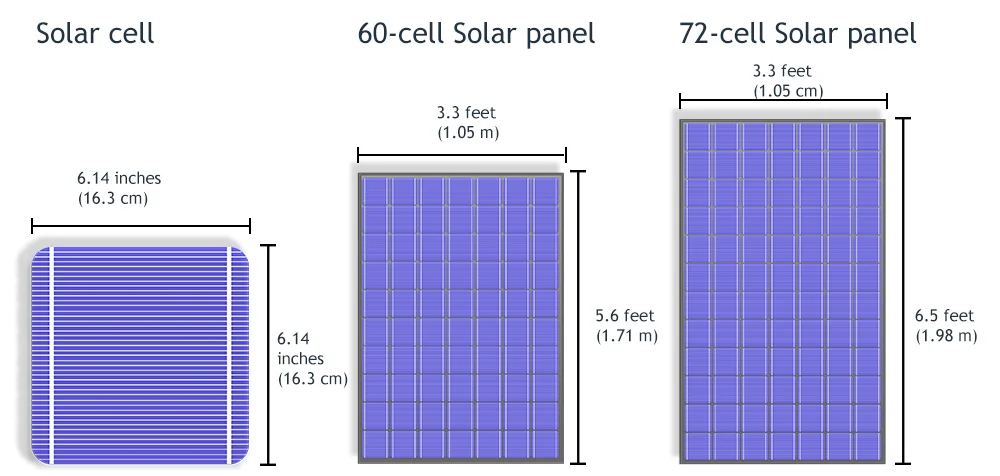
The diagram above is the typical industry classification, but as you can see from the actual datasheets, it doesn't tell you anything about the wattage — which is what you actually want to know when you're planning a system.
The one useful takeaway from the cell-count classification: most solar panels are about 1.5 inches thick. That's the depth you need for rail standoffs and airflow clearance.
Why Solar Panels Got Bigger After 2020
Until 2018, the standard silicon wafer was 156 mm square (M2 format). Then manufacturers jumped to 166 mm (M6), 182 mm (M10), and 210 mm (M12) within four years. Bigger wafers meant bigger cells, which meant bigger panels — but more importantly, lower cost per watt, because much of a panel's cost (frame, glass, junction box, labor, shipping) doesn't scale with size (DOE, 2023).
This is why a "400 W panel" from 2018 measures 78 × 39 in, while a 400 W panel today (LONGi Hi-MO 6) measures 67.8 × 44.6 in. Shorter, wider, lighter, and 30% cheaper per watt. If you're comparing quotes from different installers, don't assume same wattage means same panel — always check the actual model number against the manufacturer datasheet.
Real Solar Panels At Each Size Class
Five current residential models so you can verify the averages above against actual datasheets:
| Model | Watts | Dimensions | Weight | Cell efficiency |
|---|---|---|---|---|
| LONGi Hi-MO 6 LR5-54HTH | 410 W | 67.8 × 44.6 × 1.18 in | 47.0 lb | 22.8% |
| REC Alpha Pure-R | 430 W | 68.1 × 44.0 × 1.18 in | 47.4 lb | 22.3% |
| Q CELLS Q.PEAK DUO BLK ML-G10+ | 410 W | 74.0 × 41.1 × 1.26 in | 49.6 lb | 20.6% |
| SunPower Maxeon 6 AC | 440 W | 73.7 × 40.3 × 1.57 in | 51.0 lb | 22.8% |
| Trina Vertex S+ NEG9R.28 | 440 W | 68.5 × 44.6 × 1.18 in | 47.6 lb | 22.5% |
Three current portable / RV models:
| Model | Watts | Dimensions | Weight |
|---|---|---|---|
| Renogy 100W 12V Monocrystalline | 100 W | 41.8 × 20.9 × 1.38 in | 14.1 lb |
| Newpowa 100W Mono | 100 W | 41.8 × 20.9 × 1.18 in | 14.0 lb |
| Renogy 200W 12V Mono | 200 W | 58.7 × 26.4 × 1.4 in | 26.5 lb |
Three commercial / utility models:
| Model | Watts | Dimensions | Weight |
|---|---|---|---|
| JinkoSolar Tiger Neo 72HL4-(V) | 580 W | 89.7 × 44.6 × 1.18 in | 71.0 lb |
| JA Solar JAM72D40 600/MB | 600 W | 91.9 × 44.6 × 1.38 in | 71.7 lb |
| Trina Vertex TSM-DEG21C.20 | 600 W | 89.7 × 44.6 × 1.38 in | 71.7 lb |
Examples By Wattage
A few worked examples for the most common sizes:
- A typical 100-watt solar panel is 41.8 inches long and 20.9 inches wide. It takes up 6.07 sq ft of area. On a 1,000 sq ft roof with 75% usable area, you could theoretically fit 123 of them — but you'd be much better off using a smaller number of bigger panels.
- A typical 300-watt solar panel is 65.8 inches long and 36.1 inches wide. It takes up 16.5 sq ft. Same 1,000 sq ft roof: about 45 panels (13.5 kW).
- A typical 400-watt 108-cell panel is 67.8 inches long and 44.6 inches wide. It takes up 21 sq ft. Same 1,000 sq ft roof: about 35 panels (14 kW). This is the sweet spot for U.S. residential in 2026.
- A typical 580-watt commercial panel is 89.7 inches long and 44.6 inches wide. It takes up 27.8 sq ft. You wouldn't normally use these on a residential roof — they're awkward to maneuver up a ladder and don't fit well around skylights.
How Thick Are Solar Panels?
Residential panels in 2026 are 30 to 40 mm (1.18 to 1.57 in) thick. The variation comes from three things:
- Frame depth. Standard aluminum frames are 35 mm. Reduced frames (Q CELLS, REC) are 30 mm. SunPower Maxeon's bonded-backsheet design is 40 mm.
- Glass thickness. Front cover glass is 3.2 mm tempered glass. Bifacial glass-glass panels add a 2 mm rear glass layer.
- Cell + encapsulant stack. Roughly 0.5 mm.
For mounting clearance and rail height, plan on 1.5 inches as a safe assumption. You'll also want a minimum 3-inch air gap between the panel back and the roof surface for cooling — high cell temperature is the single biggest source of summer power loss.
How Much Do Solar Panels Weigh?
Modern panels weigh 2.3 to 2.6 lb per square foot (11 to 13 kg/m²), regardless of wattage. For a deeper breakdown of panel weight by type and the structural math, see how much do solar panels weigh. The weight scales linearly with area:
- 100 W portable → 14 lb (6.4 kg)
- 200 W small → 27 lb (12.2 kg)
- 400 W residential → 47 lb (21.3 kg)
- 580 W commercial → 71 lb (32.2 kg)
- Mounting hardware → roughly 0.5 lb per sq ft on top of panel weight
A typical 6 kW residential array (15 × 400 W panels) — enough to power most of an average house — puts about 2.8 psf of dead load on the roof structure. That is well under the 20 psf snow loads most U.S. roofs in northern climates are engineered for, and far under the 30+ psf required by the IRC for habitable structures. Roof-load is almost never the limiting factor for residential solar — fire-code setbacks and shading are.
Will A Solar System Fit On Your Roof?
Quick math:
Max system size (watts) = roof area × 0.75 × 20 W/sq ft
| Roof area | Usable (75%) | Max system | Approx. 400 W panels |
|---|---|---|---|
| 500 sq ft | 375 sq ft | 7.5 kW | 18 |
| 1,000 sq ft | 750 sq ft | 15 kW | 37 |
| 1,500 sq ft | 1,125 sq ft | 22.5 kW | 56 |
| 2,000 sq ft | 1,500 sq ft | 30 kW | 75 |
The 75% factor accounts for fire-code setbacks (NFPA 1 typically requires 18 in around the ridge and edges of the roof for firefighter access), obstructions (vents, skylights, chimneys), and mismatched roof sections. For a more precise number that uses your actual roof shape, orientation, and pitch, use the rooftop solar calculator.
For a deeper look at the watts-per-square-foot number specifically — and how it varies between budget and premium panels — see solar panel watts per square foot.
A Note On Solar Panel Efficiency
The reason a 2026 400 W panel is physically smaller than a 2018 400 W panel is cell efficiency — the percentage of incoming sunlight that gets converted to electricity. The current commercial maximum is about 22.8% for SunPower Maxeon (interdigitated back contact) and JinkoSolar Tiger Neo (n-type TOPCon) — both monocrystalline designs. Lab cells from NREL's Best Research-Cell Efficiency Chart have hit 27.3% for single-junction crystalline silicon (NREL, 2024), so there is still some room to grow before we hit the Shockley–Queisser limit of ~33% for a single-junction cell.
What this means in practice: panels will keep getting smaller per watt for the next few years, but not dramatically. The big jump from 17 to 21 W/sq ft has already happened. From here, expect 1–2% per year — useful, but not enough to make a 2026 install obsolete by 2030.
Bottom Line
If you're planning a residential install in 2026, design around the 108-half-cut TOPCon format: roughly 68 × 44 × 1.2 inches, 47 lb, 400–440 W. That's what most quality installers are putting on roofs right now, and it's the format that gives you the best balance of watts-per-square-foot, weight, and ease of handling. For an RV, boat, or shed, the 100 W portable form factor (42 × 21 in, 14 lb) is still the universal standard.
Keep Reading
- How To Calculate Solar Panel Output
- Solar Panel Watts Per Square Foot
- Peak Sun Hours Calculator — Find PSH At Your Location
- Average Peak Sun Hours By State
- How Many kWh Does A Solar Panel Produce Per Day
- Rooftop Solar Calculator — How Many Panels Fit On Your Roof
- How Much Power A 5 kW Solar System Produces
- How Many Panels In A 1kW, 5kW, 10kW Solar System
Frequently Asked Questions
What is the standard size of a solar panel?
How big is a 400-watt solar panel?
How big is a 100-watt solar panel?
How thick are solar panels?
How much does a solar panel weigh?
What's the difference between 60-cell and 72-cell solar panels?
Do all 400-watt solar panels have the same dimensions?
How many solar panels fit on a 1,000 sq ft roof?
What is the most efficient solar panel size in 2026?
Sources
- [nrel-efficiency] NREL — Best Research-Cell Efficiency Chart (interactive, updated quarterly)
- [doe-pv-basics] U.S. Department of Energy — Solar Photovoltaic Cell Basics
- [iec-61215] IEC 61215-1:2021 — Terrestrial photovoltaic (PV) modules: Design qualification and type approval
- [nfpa-1] NFPA 1 (Fire Code) §11.12 — Solar Photovoltaic Systems setback requirements
- [longi-himo6] LONGi Hi-MO 6 Explorer (LR5-54HTH 410-435M) datasheet — 2024
- [jinko-tiger-neo] JinkoSolar Tiger Neo N-type 72HL4-(V) datasheet — 580W
- [sunpower-maxeon6] Maxeon 6 AC datasheet — 440W
- [rec-alpha-pure-r] REC Alpha Pure-R datasheet — 430W
- [qcells-mlg10] Q CELLS Q.PEAK DUO BLK ML-G10+ datasheet — 405W
- [trina-vertex-s-plus] Trina Solar Vertex S+ NEG9R.28 datasheet — 440W
- [renogy-100w] Renogy 100W 12V Monocrystalline RNG-100D-SS datasheet